 Chinese
 German
 Spanish
 Japanese
 Korean

Mobile mapping vs traditional surveying; which is right for your project? As mobile mapping grows in popularity and prevalence, many surveyors are asking themselves that exact question.
Mobile mapping can offer faster, more cost-effective ways to meet the growing demand for geospatial data, especially in environments where traditional surveying struggles to deliver. In this blog, we’re discussing the differences between traditional surveying practices and mobile mapping, and the use cases for each in surveying.
What is traditional surveying?
Though some people are still surveying with completely analogue methods, for the purposes of this article we’re considering traditional surveying to be any survey carried out from static locations. That includes total stations, laser levels, and tripod-mounted LiDAR. These technologies have all been in use for decades, and are well-established in the surveying community.
What is mobile mapping?
In contrast to traditional surveying, mobile mapping is surveying done from a moving vehicle. That can be a land-based vehicle such as a car, or an aerial vehicle such as a drone or a light aircraft.
Generally, the most popular sensor for mobile mapping surveys is LiDAR. But mobile mapping surveys can be done with radar, photogrammetry, or even hyperspectral imaging.
Benefits of traditional surveying
Traditional surveying practices offer a number of benefits compared to mobile mapping:
1. High precision (at the cost of mobility)
Because traditional surveying methods are conducted using stationary sensors, they are able to gather highly precise data. However, that precision comes at the cost of flexibility – in order to move around a site, the sensors must be physically picked up and moved around.
2. Ease of deployment
Many surveyors already own the equipment needed for traditional surveying and are experienced with the accompanying software, making it a simple choice to deploy in many instances. However, the growing demand for geospatial data in challenging locations mean this choice could leave surveyors with gaps in their data.

Benefits of Mobile Mapping
When compared with traditional surveying, mobile mapping primarily offers greater flexibility, and the ability to survey in spaces that traditional surveying cannot.
1. Flexibility
Because mobile mapping payloads can move around, they are able to capture a site more easily and efficiently than surveying from fixed points. In many mobile LiDAR surveying setups, a 360-degree LiDAR is used, making the capture even simpler and eliminating the risk of discovering blind spots in your survey data during post processing.
2. Distance covered
Mobile mapping lends itself well to surveying large areas such as rail corridors, road networks, and landscapes. Instead of surveying a road by manually moving total stations, for instance, the payload can be mounted to a car and driven down the road. Aerial surveying, of course, allows you to cover distances orders of magnitude larger than traditional surveyors on foot can achieve. Using drones or UAVs can also open up previously inaccessible areas like cliff faces and off-road areas.
3. Safety
Mobile mapping enables surveyors to capture a site remotely by piloting a drone, or to be safely within a car instead of by a roadside. As a result, the risk of injury is greatly reduced.
4. Speed
Mobile mapping can capture large areas faster than traditional surveying methods can, reducing survey time and making surveying more cost-effective.
5. Performance without GNSS
Mobile mapping platforms have access to technology designed to compensate for poor GNSS signal in areas such as urban canyons, or even when completely indoors. This enables them to provide data where total stations or fixed LiDAR scanners cannot.

Key differences between mobile mapping and traditional surveying
Data collection speed
Gathering data using traditional surveying methods is relatively slow compared to mobile mapping, even when using LiDAR. This is because mobile mapping payloads gather data constantly while moving through the site, while traditional surveying methods involve gathering data at a specific point, moving, resetting, and gathering more data.
Accuracy and precision
Generally speaking, because they are fixed, traditional surveying tools offer greater precision than mobile mapping setups. However, this comes with some caveats. Mobile mapping solutions can function in areas where traditional surveying cannot, giving mobile mapping setups greater accuracy in those locations. It is also worth considering what the required level of accuracy is for a given use case. Not every survey requires the same level of accuracy, and as long as the accuracy provided by a mobile mapping setup is sufficient, you may find the benefits make it more effective than traditional surveying.
Coverage and scalability
Mobile mapping can cover far larger areas than traditional surveying, and scales far better. After all, two cars conducting LiDAR surveys can cover far more ground than two survey teams using static LiDAR over the same time.
How to choose the right approach for your project
Given the differences between mobile mapping and traditional surveying practices, how you choose between each can feel fairly clear-cut.
If you need extremely high precision, aren’t surveying a very large area, and don’t anticipate any issues with GNSS, traditional surveying should have you covered.
If you need to survey a large area, or an area where GNSS signal is unreliable, and you have a system that provides the required level of accuracy for your use case, mobile mapping will be a better fit.
Of course, there’s no reason not to combine the two methods in theory. However, if you are able to use a mobile mapping setup, it’s hard to see why you would need to use both with the traditional setup as well – that area could be surveyed so quickly using the mobile mapping setup that there would be almost no benefit to using both.
BeeXact: a mobile mapping case study
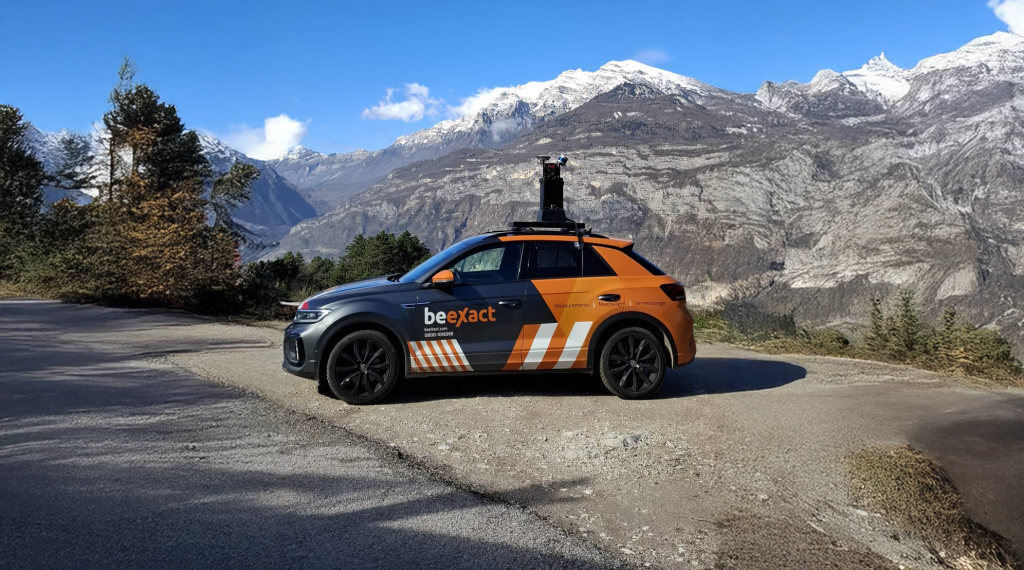
Infrastructure mapping company BeeXact won a contract to map the entirety of Italy’s fibre optic network – something that would clearly be impossible with traditional surveying techniques. To deliver the project, BeeXact turned to mobile mapping – specifically, road-based mapping, and asked OXTS to help design the survey payload.
The RT3000 v4 sits at the centre of BeeXact’s fleet of more than 80 mapping vehicles, with a custom-built data processing workflow that turns the vast quantities of LiDAR data into usable insights for BeeXact’s client.
Mobile mapping vs traditional surveying; what does the future look like?
Industry commentary indicates that in the future, surveying is likely to become increasingly automated, and to focus on providing real-time survey data. Real-time data has the potential to facilitate instant decision-making for time-sensitive applications (such as comparing as-built construction with the plans and accounting for any variances). Automation will allow surveyors to work faster, cover more ground, without compromising the quality of the final output.
Both of these will require an even greater reliance on navigation-grade positioning technology. Real-time survey data will need to be accurate enough to use with minimal, or no, post-processing; automated surveying equipment will need localisation for the navigation stack that enables the platform to move autonomously.
Luckily, OXTS GNSS/INS units are already used in all these applications. Our xNAV650, for instance, is popular with surveyors thanks to is accuracy levels and ability to be mounted to cars, planes, or even drones. Our xRED has been integrated into autonomous mobile robots to provide navigation capabilities, and the WayFinder family of products are able to perform real-time computations that would facilitate real-time surveying data.
Download the RT3000 v4 Datasheet
Learn more about our flagship mobile mapping GNSS/INS the RT3000 v4


